
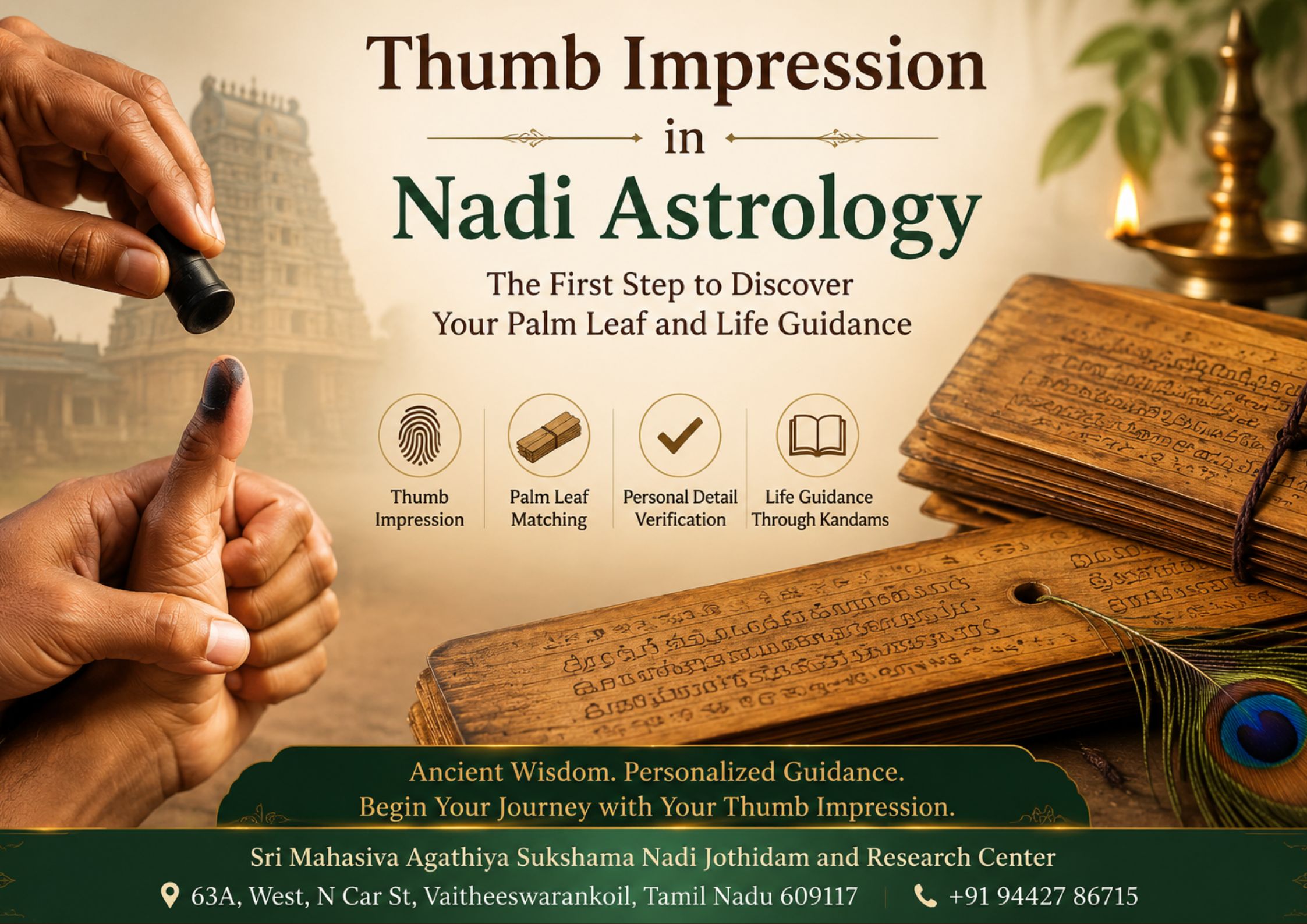
Thumb Impression in Nadi Astrology: How One Thumbprint Leads to Your Ancient Palm Leaf
Thumb impression in Nadi astrology is one of the most unique and fascinating aspects of this ancient tradition. Unlike many other forms of astrology that rely mainly on your birth date, time, and place, Nadi astrology traditionally begins with your thumb impression. This process is believed to help identify the correct palm leaf manuscript connected with guidance about career, marriage, health, family, finances, and spiritual growth.
The thumb impression is not considered a prediction by itself. Instead, it acts as the starting point for locating the correct bundle of palm leaves. Once a possible matching leaf is found and personal details are verified, the Nadi reading continues through different Kandams, or life chapters.
This guide explains why the thumb impression is important, how it is traditionally used, how a palm leaf is verified, and what generally happens during a Nadi astrology consultation.
Thumb Impression in Nadi Astrology and Its Traditional Purpose
A thumb impression is the pattern formed by the ridges on a person’s thumb. These ridge patterns are used in many identification systems because they are highly individual.
In the Nadi tradition, the thumb impression is used as a classification tool. It helps the Nadi reader narrow a large collection of palm leaves into smaller groups that may contain the seeker’s manuscript.
What Is the Role of the Thumbprint?
The thumbprint helps begin the search. It does not independently reveal life events or personal information.
Its traditional role includes:
- Classifying the thumb pattern
- Selecting a related palm leaf bundle
- Narrowing the manuscript search
- Beginning the verification process
- Helping organise the consultation
Why Is It Different from Horoscope Astrology?
Traditional horoscope astrology usually begins with the date, time, and place of birth. The astrologer then prepares a birth chart and studies planetary positions.
Nadi astrology traditionally begins with the seeker’s thumb impression. A palm leaf bundle is searched first, and personal information is verified before the reading proceeds.
Important: The thumb impression is only the first step. The Nadi reading begins after a possible palm leaf has been identified and the information on the leaf has been verified.
How Thumb Impression Matching Works in Nadi Astrology
The thumb impression process generally follows a structured sequence. Each stage helps the reader move from a broad palm leaf collection toward a possible individual manuscript.
| Step | Traditional Process |
|---|---|
| 1 | The seeker’s thumb impression is collected. |
| 2 | The thumb pattern is examined and classified. |
| 3 | A related bundle of palm leaf manuscripts is selected. |
| 4 | Possible leaves are examined one after another. |
| 5 | Personal details are verified through simple questions. |
| 6 | The correct palm leaf is identified when the details match. |
| 7 | The General Kandam is traditionally read first. |
| 8 | Additional Kandams and remedies may be explained if requested. |
Which Thumb Is Used for Men and Women?
Nadi readers traditionally follow different thumb-impression conventions for men and women.
For Men
Men traditionally provide their right thumb impression for the palm leaf search.
For Women
Women traditionally provide their left thumb impression for the palm leaf search.
This convention has been followed by many traditional Nadi readers for generations and is considered an important part of the palm leaf classification process.
Does the Thumb Impression Predict the Future?
No. The thumb impression itself does not predict future events or reveal personal information.
Its purpose is to help locate a possible palm leaf bundle. The main reading begins only after:
- A possible leaf has been found
- Personal details have been checked
- The information matches the seeker
- The reader confirms the manuscript
Why Are Verification Questions Asked?
The reader may ask questions connected with information stated on a possible palm leaf.
These questions may relate to:
- Parents’ names
- Family background
- Marital status
- Number of siblings
- Other identifying details
If the details do not match, the reader moves to another leaf and continues the search.
Why Is a Thumb Impression Used Instead of Birth Details?
Many visitors are surprised that a traditional Nadi consultation may begin without depending primarily on an exact birth time.
The thumb impression provides a different starting method. It helps classify the seeker and identify a smaller manuscript group before the verification process begins.
This approach is one of the main features that separates Nadi astrology from horoscope-based astrology. Both systems may offer guidance about similar areas of life, but they begin with different information and follow different processes.
A person who does not know the exact birth time may still explore a traditional Nadi reading because the palm leaf search begins with the thumb impression.
What Happens After the Correct Palm Leaf Is Found?
Once the reader verifies that the personal details match, the reading commonly begins with the General Kandam.
The General Kandam may introduce:
- Family background
- Personal characteristics
- Important life themes
- Broad life direction
- Major stages of the seeker’s journey
Additional Kandams may then be selected depending on the seeker’s questions and interests.
Can Thumb Impressions Change Over Time?
The thumb impression used during the consultation is the visible pattern collected when the reading is arranged.
Traditional Nadi astrology uses the impression for classification and palm leaf identification. The consultation does not normally focus on studying how the thumb pattern may change over time.
Why Do People Find the Process Unique?
The method attracts people because it differs from a normal horoscope consultation.
- Thumbprint-based classification
- Ancient palm leaf search
- Personal detail verification
- Organised Kandam readings
- Traditional spiritual guidance
The Connection with Vaitheeswarankoil
Vaitheeswarankoil in Tamil Nadu has a longstanding association with the tradition of Nadi palm leaf reading. Visitors from India and other countries travel to the town to learn about this distinctive form of astrology.
You can read more about the history and location of Vaitheeswaran Koil through this external reference.
The town’s connection with ancient temples, palm leaf collections, Tamil Siddhar traditions, and generations of Nadi readers has made it an important destination for seekers.
Sri Mahasiva Agathiya Sukshama Nadi Jothidam and Research Center
People interested in experiencing a traditional thumb impression and palm leaf identification process may contact Sri Mahasiva Agathiya Sukshama Nadi Jothidam and Research Center in Vaitheeswarankoil.
The center follows the traditional sequence of collecting the thumb impression, classifying the pattern, searching palm leaf bundles, verifying identifying details, and explaining the relevant Kandams.
Center Address
Sri Mahasiva Agathiya Sukshama Nadi Jothidam and Research Center63A, West, N Car St,
Vaitheeswarankoil,
Tamil Nadu – 609117
Frequently Asked Questions About Nadi Thumb Impressions
1. Why is the thumb impression important in Nadi astrology?
The thumb impression is traditionally used to classify the seeker and locate a possible bundle of palm leaf manuscripts before the reading begins.
2. Which thumb is used for a Nadi reading?
Traditionally, men provide their right thumb impression, while women provide their left thumb impression.
3. Does the thumb impression itself reveal the future?
No. The thumb impression is used as a classification and search tool. The reading begins after the correct palm leaf is identified and verified.
4. Why does the reader ask personal questions?
The questions help confirm whether the information on a possible palm leaf matches the seeker. If it does not match, another leaf is examined.
5. Can I have a Nadi reading without knowing my birth time?
Yes. Traditional Nadi astrology usually begins with the seeker’s thumb impression rather than relying primarily on the exact birth time.