- Guruji Dr. M.S. Gopinath Swamy Ph.D
- +91-9442786715
- +91-9442786715
- Vaitheeswarankoil
The Untold History of Nadi Astrology Explained Simply
The history of Nadi astrology takes us back thousands of years into the spiritual traditions of ancient India, where sages recorded human destinies on palm leaves with deep insight and knowledge. Unlike many modern systems of prediction, this practice is a preserved legacy of divine wisdom, connecting past, present, and future through a structured method that continues even today. It is widely believed that these records were specifically intended for the "souls of the future" who would seek guidance during times of great transition or personal crisis. The sages utilized their extraordinary spiritual vision to transcribe the patterns of life that would help individuals navigate their karma effectively across multiple lifetimes.
For many seekers, understanding the story behind these records creates a stronger sense of trust and curiosity. How did such a unique system come into existence, and how has it survived for centuries? The answer lies in the selfless dedication of the Siddhars, who viewed time as a circular reality where the beginning and end are visible to the enlightened eye. This ancient database remains one of the world's most mysterious and accurate systems of spiritual guidance, offering a unique bridge between the material and the metaphysical.
The Origin and History of Nadi Astrology in Ancient India
Nadi astrology is believed to have originated in ancient Tamil Nadu, where enlightened sages, also known as Siddhars, possessed extraordinary spiritual abilities. Among the 18 celebrated Siddhars of the Tamil tradition, Agathiyar (Agastya) stands as the primary architect of the Nadi system. He documented the life paths of millions of souls on specially treated palm leaves using his "Trikala Gnani" (knowledge of three times) abilities. These sages did not just predict; they provided a roadmap for spiritual evolution, helping humans align with their higher purpose.
This process was a profound meditation on the vibrations of the soul. These sages were said to have written the destinies of individuals who would not even be born for thousands of years. They understood that every action creates an imprint, and by reading these imprints on the palm leaves, they could offer remedies to balance one's life. The continuity of this tradition is a miracle of preservation, as the leaves were recopied onto fresh palm material every few centuries by dedicated lineages to prevent them from crumbling into dust.
The Role of Siddhars in the History of Nadi Astrology
Siddhars were the polymaths of ancient India. Their influence on the history of Nadi astrology is inseparable from their contributions to medicine, alchemy, and yoga. They believed that human suffering is often a result of "Karma," which manifests as blockages in one's current path. By recording these destinies, they provided a spiritual "roadmap" for individuals to clear these blockages through specific remedies (Pariharams). Their legacy is not just in prediction, but in the holistic healing of the human spirit through the balancing of cosmic energies.
Palm Leaf Manuscripts – The Sacred Medium of Destiny
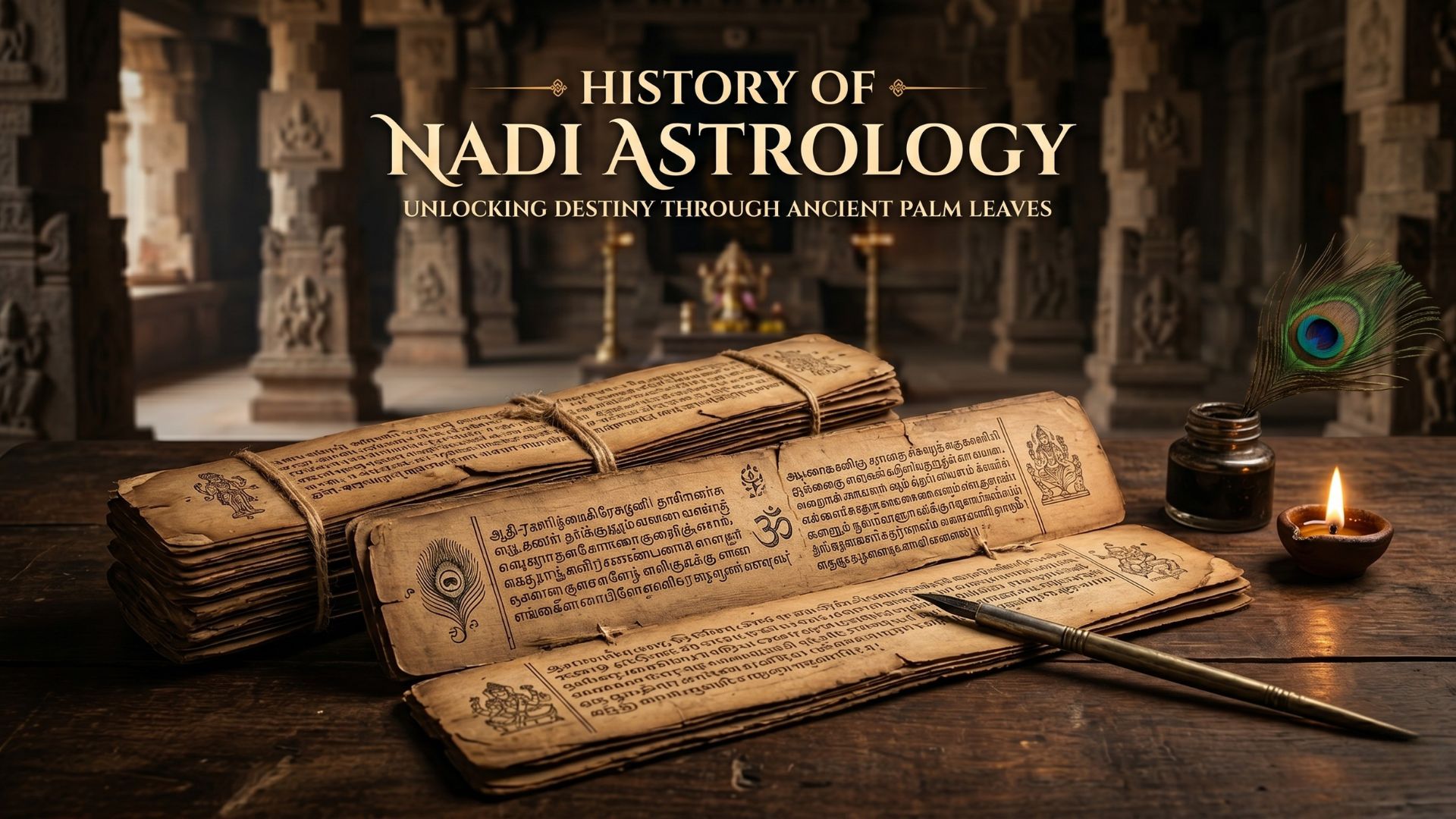
The core of this tradition lies in the Olai Chuvadi. These were harvested from specific palm trees, boiled in medicinal herbs, and etched using a sharp stylus called an "Ezuthani." This process required immense precision to avoid breaking the brittle leaf. Once complete, a mixture of lamp oil and turmeric was applied to make the ancient script jump off the page. These leaves were then bundled according to thumbprint patterns, creating a biological indexing system that remains unique and highly sophisticated even by modern standards.
The Science of Thumbprint Classification
The Nadi system classifies human thumbprints into 108 primary categories. Men use their right thumb, and women use their left. These patterns—known as "Shanka" and "Chakra"—serve as the filing system for the vast library of Nadi leaves. This proves that ancient Indian science was far ahead of its time in biometric identification, using the unique identity of a person to retrieve their eternal life story.
Preservation and the Library at Vaitheeswarankoil
King Serfoji II of Thanjavur recognized the value of these leaves and stored them in the Saraswathi Mahal Library. Later, traditional families from Vaitheeswarankoil purchased them, ensuring the survival of the practice in its purest form today. This temple town has since become the global epicenter for those seeking their authentic palm leaf records, drawing thousands of spiritual seekers annually.
Kandams: The Comprehensive Roadmap of Your Life
| Chapter (Kandam) | Focal Point of Life | Detailed Insight Provided |
|---|---|---|
| Kandam 1 (General) | Life Path & Identity | Names of parents, spouse, and current life summary. |
| Kandam 2 (Wealth) | Finances & Education | Income sources, family speech, and academic success. |
| Kandam 7 (Marriage) | Relationships | Timing of marriage, nature of spouse, and harmony. |
| Kandam 10 (Career) | Profession | Job prospects, business growth, and social status. |
| Kandam 13 (Karma) | Past Life | Sins of the past life and their current impact. |
| Kandam 14 (Remedies) | Pariharams | Spiritual tasks to mitigate negative planetary influences. |
The Spiritual Philosophy of Karma and Free Will
A common misconception is that Nadi astrology implies a fatalistic view of life. In reality, the history of this system emphasizes that while past actions set the stage, our current actions can influence the future. The Nadi reading is a diagnostic tool; it identifies the "diseases" of the soul and prescribes "medicine" in the form of temple visits or meditation. It is a system of empowerment that gives you the tools to change your course and achieve spiritual liberation (Moksha).
Experience Authenticity Today
In the modern age, finding a trusted source for your reading is essential. At the Sri Mahasiva Agathiya Sukshama Nadi Jothidam and Research Center, we honor the ancient lineage of Vaitheeswarankoil readers.
Address: 63A, West, N Car St, Vaitheeswarankoil, Tamil Nadu 609117
Phone: +91 94427 86715
Website: agasthiyasukshamanadi.com